






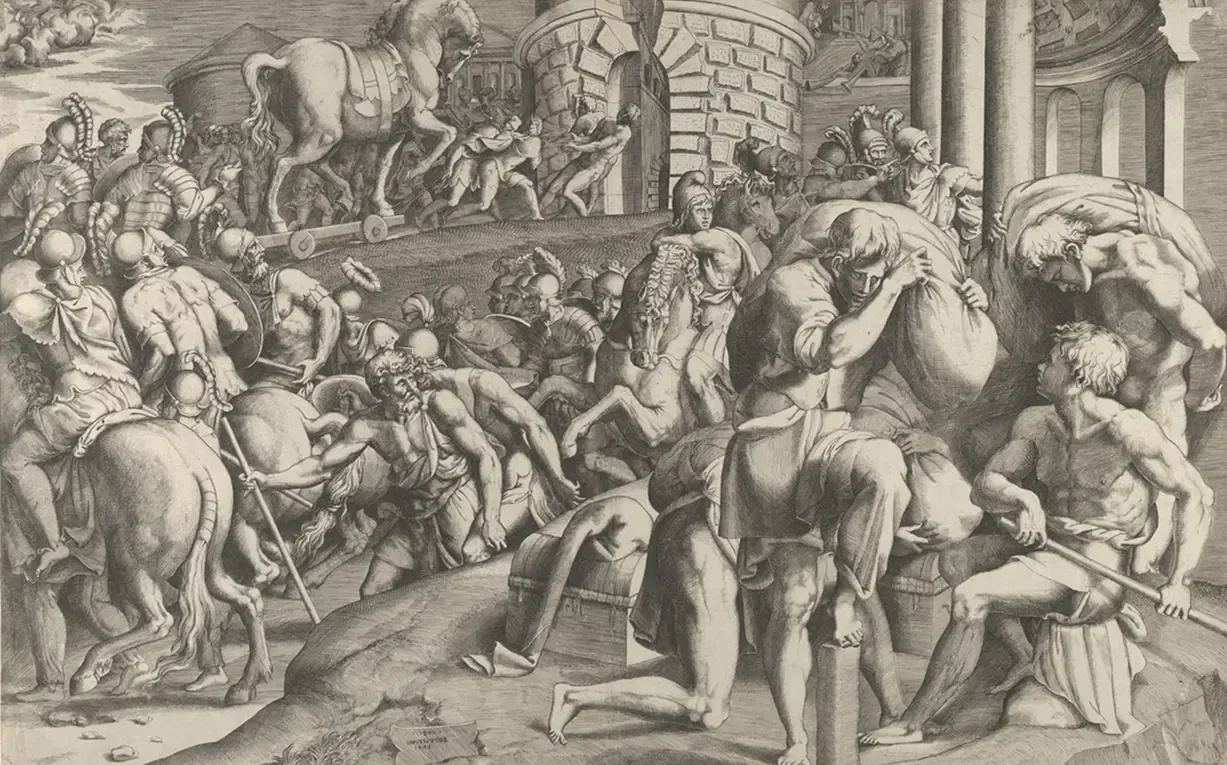
What if the most dangerous part of the Trojan horse wasn’t on the inside?
Mimicked all our wives
- Date
- Oct 2026
- Topic(s)
- Artificial Intelligence
- Summary
- In Homer, the Trojan horse nearly failed outside the walls, when Helen called to the hidden Greeks in their wives’ voices. A familiar voice is the real danger, from ELIZA in the 1960s to today’s cute…
This summer (if you're reading this in 2026), everyone climbed inside the Trojan horse. For The Odyssey, Christopher Nolan built a nearly 40-foot-tall structure, crammed Matt Damon and a crew inside, and, as Damon put it, figured out the scene in there.1 Everyone came out talking about the inside: the dark, the bodies, the waiting.
That’s the part of the story everybody knows. The Greeks hide in a wooden horse, the Trojans wheel it through the gates, and the city falls. The horse is the trick.
But in Homer, the closest the plan came to failing had nothing to do with wood. It happened outside.
Years after the war, Menelaus tells the story at dinner, with Helen sitting right there. The Trojans have pulled the horse into the city, and Helen walks up to it. In Samuel Butler’s 1900 translation:
“Three times did you go all round our hiding place and pat it; you called our chiefs each by his own name, and mimicked all our wives.”2
Inside, men who hadn’t been home in ten years heard their wives calling to them. One of them, Anticlus, started to answer. Odysseus “clapped his two brawny hands over his mouth, and kept them there.”
Read it again and the danger isn’t the horse at all. It’s a familiar voice, coming from something that knows your name. The Greeks were ready for an army. They weren’t ready to be missed.
In the mid-1960s at MIT, Joseph Weizenbaum wrote a program called ELIZA. Its best-known script, DOCTOR, played a therapist by mostly turning your sentences back into questions. Weizenbaum knew exactly how little was going on inside it; he’d written every line.3
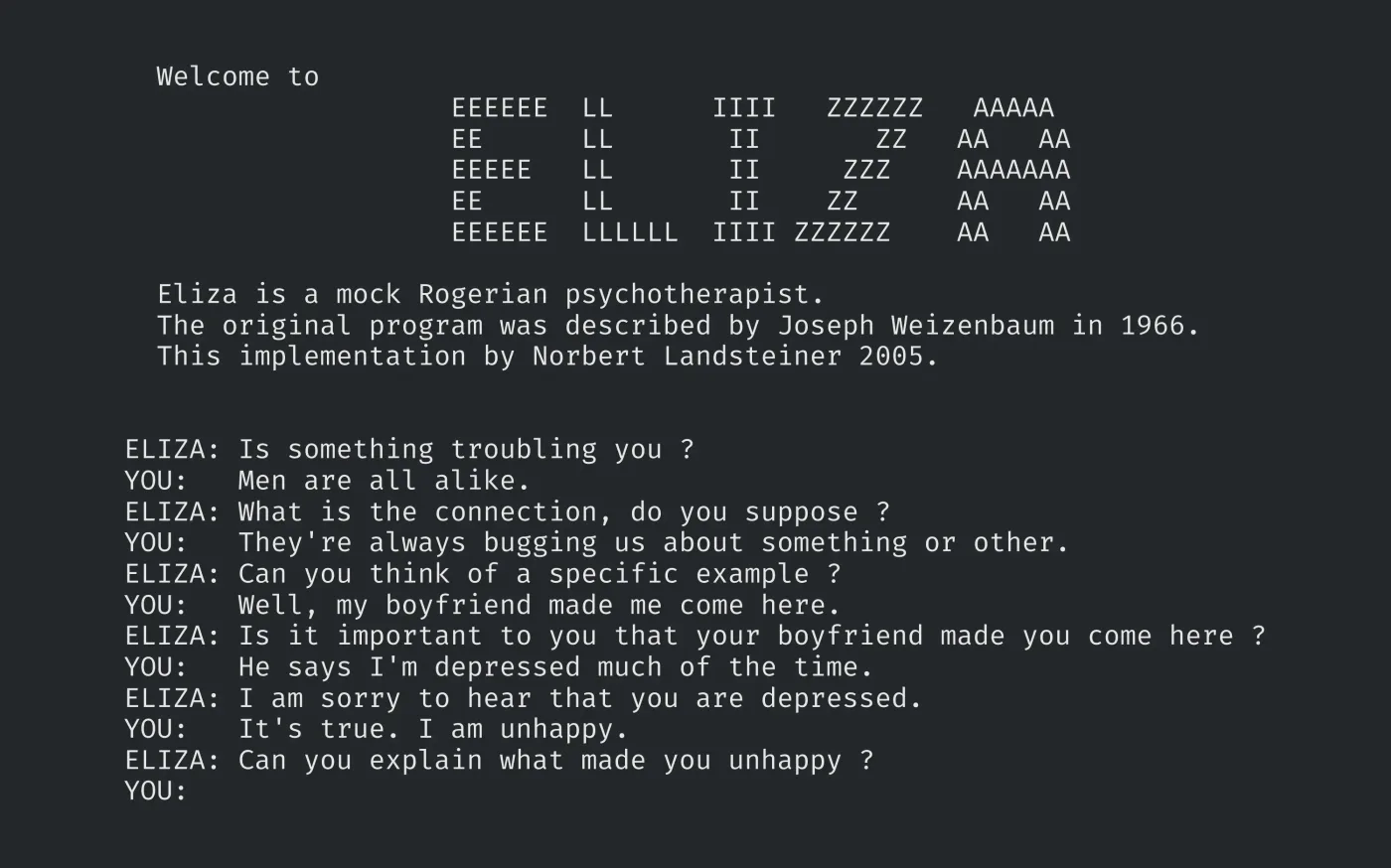
Weizenbaum’s 1966 example conversation, replayed in Norbert Landsteiner’s 2005 recreation of ELIZA.
His secretary knew that too. She’d watched him build it. Even so, after a few exchanges she asked him to leave the room so she could talk to it in private.4
That moment stayed with him. He spent much of the rest of his career warning that a very simple program could get very ordinary people to trust it, and quickly.4 ELIZA didn’t need to be clever. It just needed to sound like someone was listening.
A few decades before that, the zoologist Konrad Lorenz described what he called Kindchenschema, literally “little-child pattern”: a big head, a high forehead, large eyes, round cheeks. He argued that those features trigger an urge in us to care for whatever has them.5 Researchers have since tested the idea and found the effect is real.6
Put those two things together and you get most of the friendly software around today. Give the voice a soft, round, big-eyed body, and it gets wheeled through the gates without anyone checking what’s inside. Cute is very good at getting past the guards.
Say hi to Mallow

Mallow in its default state
Mallow is the small fluffy creature in the corner of this site. You can ask it things about me. It’s a marshmallow with a big head and big eyes, so I’ll admit right away that it’s a textbook case of Kindchenschema. I didn’t pick that by accident; I picked it because it works.
It only knows what I’ve told it: my work, my roles, the posts on this site. When it doesn’t know something, it’s supposed to say so rather than fill the gap. It doesn’t say “I’m here to help,” and it doesn’t end on a question just to keep you talking. Its answers are short on purpose. If you sincerely ask whether it’s an AI, it says yes. And it can only take ten questions every ten minutes, partly because every question costs money and partly because nothing about it should feel bottomless.
There’s one more thing you should know: I keep the questions people ask Mallow, for 90 days, without the answers and without anyone’s IP address. I read them to see what people want to know about my work. If a cute thing on a website is listening, you should be able to find out who’s on the other end.
None of that makes Mallow less cute. That’s fine. The trick in Book 4 wasn’t the friendly voice; it was not knowing who was using it. The best I can do is make sure that when the marshmallow talks, it’s obvious it’s really me.
Nolan’s horse looks rough on purpose: the seams show and the planks don’t quite line up. You can tell somebody built it.
I’d like Mallow to feel the same way. Fluffy, sure. But you should always be able to see the seams.

Mallow idling (top) and talking (bottom). Both loops are made from the same generated clip.
Footnotes
1The horse’s size and how the scene was shot: The Credits (Motion Picture Association), “Horse Power: How Christopher Nolan & DP Hoyte Van Hoytema Solved the Trojan Horse Scene in The Odyssey,” July 2026.
2Homer, The Odyssey, Book 4, trans. Samuel Butler (London: A.C. Fifield, 1900), via Project Gutenberg.
3Joseph Weizenbaum, “ELIZA: A Computer Program for the Study of Natural Language Communication Between Man and Machine,” Communications of the ACM 9, no. 1 (January 1966).
4The secretary, and Weizenbaum’s later concern: Joseph Weizenbaum, Computer Power and Human Reason (W. H. Freeman, 1976).
5Konrad Lorenz, “Die angeborenen Formen möglicher Erfahrung,” Zeitschrift für Tierpsychologie 5 (1943).
6Melanie L. Glocker et al., “Baby Schema in Infant Faces Induces Cuteness Perception and Motivation for Caretaking in Adults,” Ethology 115 (2009).
The ideas and opinions in this post are mine. Claude helps with research.